
If you’ve been watching your baby lift their head, rock on all fours, or scoot backward instead of forward, you’ve probably typed some version of “when do babies start crawling” into a search bar more than once. It’s one of those milestones that feels like it should have a clean answer — but it doesn’t, and that’s actually normal.
Crawling isn’t a single skill that switches on overnight. It’s the product of weeks (sometimes months) of smaller developments: neck strength, core stability, coordination between the left and right sides of the body, and enough motivation to actually move toward something. Some babies crawl early and skip other stages. Some skip crawling altogether and go straight to walking. Both can be completely fine.
This article walks through the realistic timeline, the physical building blocks that come before crawling, the different styles babies use, and what’s worth mentioning to a pediatrician versus what’s just normal variation.
The Short Answer: Typical Age Range for Crawling
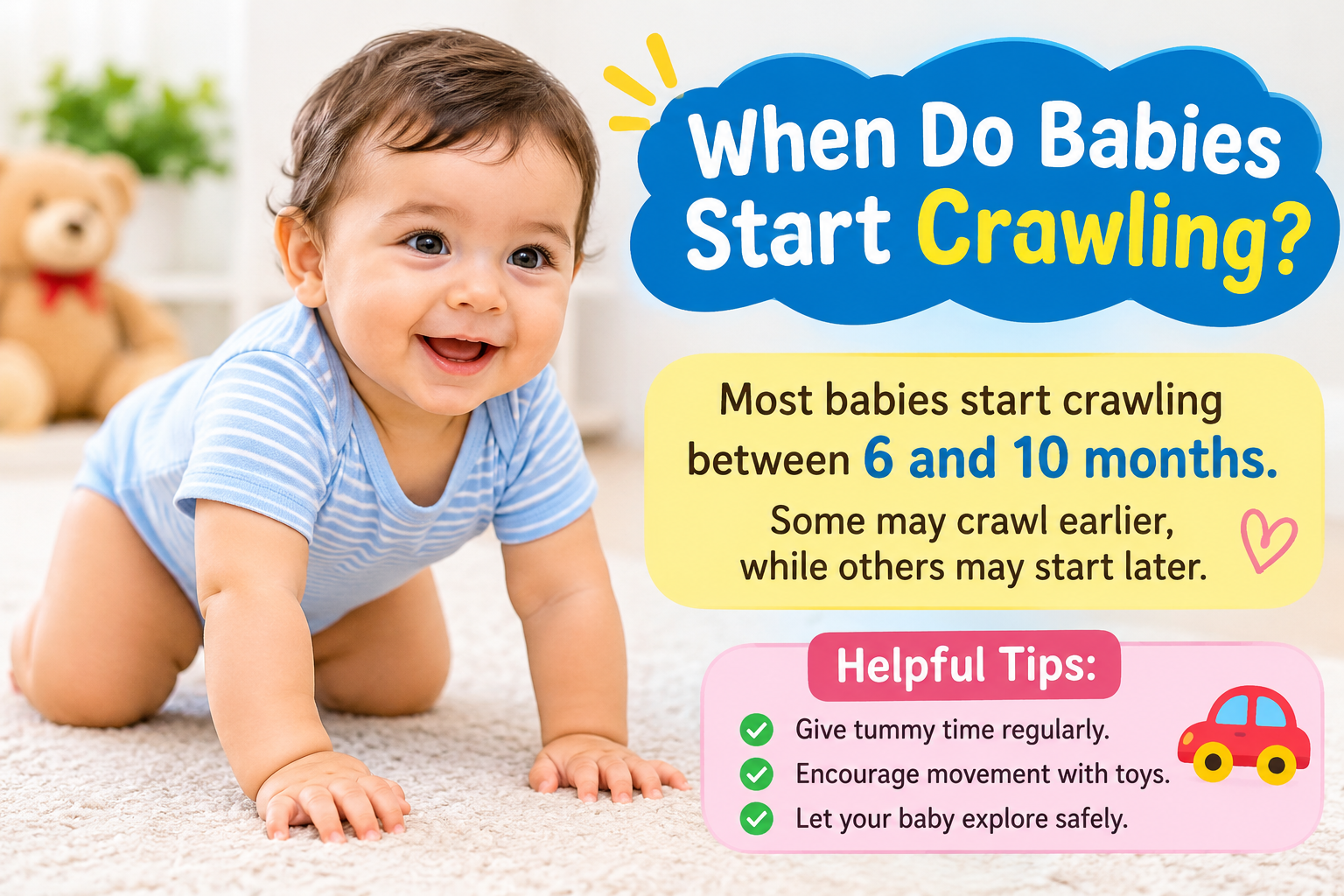
Most babies begin crawling somewhere between 6 and 10 months old, with many babies hitting a recognizable crawling pattern around 8 or 9 months. Some babies show early attempts as young as 5 months, and others don’t crawl in a traditional sense until closer to 11 or 12 months.
A few important caveats:
- “Crawling” isn’t one specific movement. Some babies do a classic hands-and-knees crawl. Others scoot on their bottom, roll to get where they want to go, or do a commando-style crawl on their belly. All of these count as mobility milestones.
- Some babies never crawl at all. A notable percentage of babies skip crawling entirely and move straight from sitting to pulling up to walking. This is considered a normal developmental variation, not a red flag on its own.
- Premature babies are usually assessed by adjusted age, not birth age, when it comes to motor milestones like crawling.
If your baby is outside this window in either direction, it doesn’t automatically mean something is wrong — but it’s a reasonable thing to bring up at a well-child visit, especially if it comes with other developmental concerns.
The Building Blocks: What Happens Before Crawling
Crawling is really the finish line of a longer sequence. Understanding the steps before it can help you recognize progress even when your baby isn’t moving across the floor yet.
1. Head and neck control (around 2–4 months)
Before a baby can support their body weight on their arms, they need to be able to lift and hold their head up during tummy time. This usually develops steadily over the first few months.
2. Rolling over (around 4–6 months)
Rolling — both belly-to-back and back-to-belly — builds the core and trunk strength babies need later for crawling. It also introduces the idea that movement can be intentional.
3. Sitting without support (around 6–8 months)
Independent sitting is a strong indicator that a baby’s core and back muscles are developing well. Many babies pass through a phase of sitting and reaching before they attempt to move forward.
4. Getting into a hands-and-knees position (around 6–9 months)
This is often the clearest early sign that crawling is close. A baby might rock back and forth on all fours, testing stability, well before they figure out how to actually move forward or backward.
5. Combining movement with direction (around 7–10 months)
Eventually, rocking turns into an actual shift of weight from one hand/knee to the other, and the baby starts propelling themselves — even if the first attempts go backward instead of forward.
Common Crawling Styles (They’re All Normal)
One thing that surprises a lot of parents: the “classic” hands-and-knees crawl is common, but it’s far from the only pattern. Here are styles you might see:
- Classic crawl – hands and knees, alternating limbs, the version most people picture.
- Bear crawl – hands and feet instead of hands and knees, legs straighter.
- Commando/army crawl – belly stays on the ground, baby pulls forward mostly with the arms.
- Bottom scooting – baby sits upright and scoots forward using their legs and hands, without ever going onto all fours.
- Rolling – some babies get around almost entirely by rolling in the direction they want to go, before or instead of crawling.
If your baby has found a way to get where they want to go, that’s the meaningful part — the exact form matters far less than most parents assume.
Signs Crawling Is Coming Soon
A few behaviors tend to show up in the weeks leading up to crawling:
- Getting up on hands and knees and rocking back and forth
- Pushing up into a “downward dog” style position with straight arms and legs
- Reaching for toys while in a hands-and-knees position, even if they tip over
- Moving backward before figuring out forward (this is extremely common and often frustrates babies before it clicks)
- Pivoting in a circle while sitting, reaching for things just out of range
If you’re seeing this kind of experimentation, forward crawling is often just a few weeks away.
How to Support Crawling (Without Forcing It)
You can’t make a baby crawl before their body is ready, and trying to rush it isn’t necessary or particularly effective. What actually helps is giving them the right conditions to practice.
Do:
- Give plenty of supervised tummy time, starting early and building duration gradually. This is one of the most consistent contributors to the strength babies need for crawling.
- Put toys slightly out of reach during floor play so there’s a reason to move toward something.
- Let your baby practice on different surfaces — a firm floor is generally easier to push off from than soft carpet or bedding.
- Get down on the floor with them. Babies are often motivated to move toward a parent’s face or voice more than toward an object.
- Baby-proof early, even before crawling starts. Once it clicks, mobility can progress quickly.
Avoid:
- Overusing containers like bouncers, swings, and stationary activity centers for long stretches. Occasional use is fine, but babies need floor time to build the strength crawling requires.
- Skipping tummy time because a baby dislikes it. Short, frequent sessions are more effective than avoiding it altogether.
- Comparing too closely to other babies. The range of “normal” here is genuinely wide, and comparison tends to create unnecessary worry.
- Using walkers as a substitute for floor practice. Many pediatric organizations advise against baby walkers on wheels due to both safety concerns and the fact that they don’t support natural motor development.
Mistakes Parents Commonly Make Around This Milestone
A few patterns come up often enough to be worth naming directly:
- Treating the “average age” as a deadline. Averages describe a range, not a cutoff. A baby who crawls at 10 months isn’t behind — they’re within the normal range.
- Assuming skipping crawling is a problem. Plenty of babies go straight from sitting to cruising to walking. Pediatric guidance generally treats this as a variation, not a deficiency, especially if other milestones are on track.
- Overloading tummy time all at once. Several short sessions throughout the day tend to work better than one long, frustrating stretch.
- Not baby-proofing until crawling has already started. By the time you notice consistent forward movement, a baby’s range can expand within days.
- Comparing crawling style to other kids. Bottom-scooting, commando crawling, and classic crawling all represent functional mobility — none is inherently “better.”
When to Talk to a Pediatrician
Most variation in crawling timing is completely normal and doesn’t need intervention. That said, it’s reasonable to bring up your baby’s development at a checkup — sooner if you’re concerned — if you notice:
- No independent sitting by around 9 months
- No attempt at any form of forward mobility (crawling, scooting, or rolling toward objects) by around 12 months
- Very asymmetrical movement, such as strongly favoring one side of the body
- Significant muscle stiffness or unusual floppiness
- Loss of a skill the baby previously had (this is different from simply being delayed)
Pediatricians typically look at the whole picture of development — motor skills, social engagement, communication — rather than judging crawling in isolation. If you’re ever unsure, it’s always reasonable to ask at a well-child visit rather than wait it out. Guidance and screening tools can change over time, so if you want the most current recommendations, it’s worth checking directly with your pediatrician or a current source like the CDC’s developmental milestones checklist.
What Comes After Crawling
Once a baby is reliably mobile, the next stretch of development tends to move quickly:
- Pulling to stand on furniture, often within a couple of months of crawling
- Cruising — walking while holding onto furniture for support
- Standing independently for a few seconds at a time
- First independent steps, typically somewhere in the range of 9 to 15 months, though this too varies widely
Crawling plays a meaningful role in this sequence because it builds the strength, balance, and coordination that later support walking — but it isn’t a strict requirement for every baby to walk successfully.
Frequently Asked Questions (FAQs)
1. Is crawling at 4 months early?
Yes, crawling at 4 months is considered early. Most babies start crawling between 6 and 10 months, although some may begin earlier depending on their development.
2. What is the 3-6-9 rule for babies?
The 3-6-9 rule is an informal developmental guideline that highlights common milestones around 3, 6, and 9 months, such as improved head control, sitting, and increased mobility. However, every baby develops at their own pace.
3. What is the earliest baby to crawl?
Some babies may begin crawling as early as 4 months, but this is uncommon. Most babies start crawling between 6 and 10 months, and some skip crawling altogether.
4. What is the hardest month for a baby?
There is no single hardest month for every baby. However, months 3–4 can be challenging because of sleep changes, while months 6–9 may bring teething, separation anxiety, and new developmental milestones.